 18+
18+
18+
18+
Free demo — no real money. Loads the provider's official demo build. Demos may be unavailable in some regions.
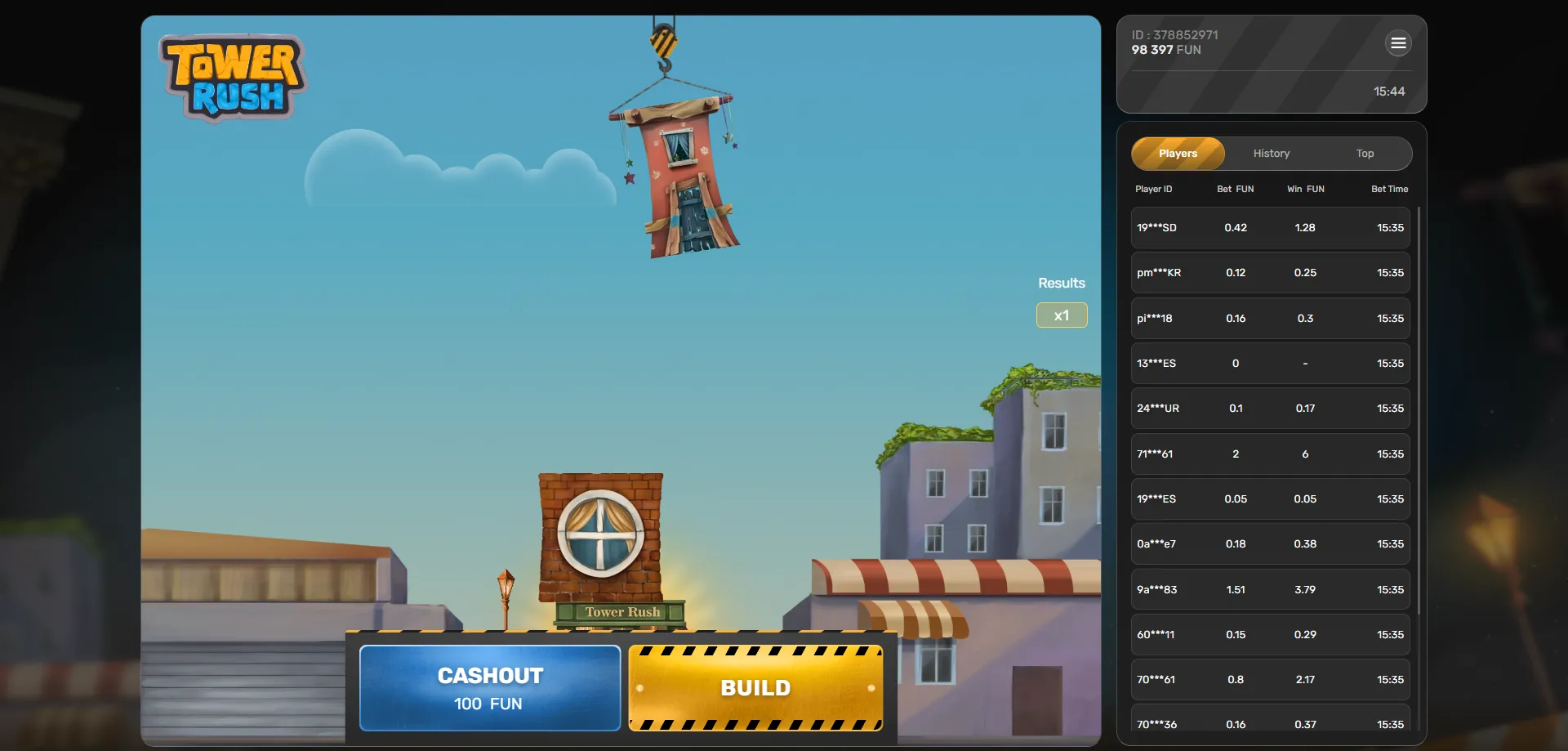
Tower Rush, developed by Galaxsys, is one of the fastest-growing crash-style titles available at online casinos in 2026. Before diving into complex systems, every player — whether brand new or a seasoned gambler — should anchor their sessions in a handful of fundamentals that apply regardless of the strategy they choose.
First and foremost, always start by exploring the demo mode. Tower Rush offers a fully functional free-play version that mirrors the real-money experience using virtual credits. This environment lets you calibrate your cash-out reflexes, test auto cash-out settings, and develop an intuitive feel for the game's pace without risking a single rupee. Demo play is available at most casinos hosting the Galaxsys catalogue, sometimes without even requiring registration.
Second, understand the game's high volatility profile. With an RTP of approximately 97% — well above the ~96% industry average for slots — Tower Rush is statistically generous over the long run. However, high volatility means outcomes swing sharply in the short term. A run of early tower collapses is perfectly normal and should never prompt panic-driven changes to your plan.
These basics form the scaffold on which every tower rush strategy worth using is built. Shortcuts that ignore them consistently lead to accelerated losses.
Whether you are placing your first real-money bet or returning after months of play, the following four approaches cover the strategic spectrum from ultra-conservative to calculated high-risk. Study each one carefully and match it to your current bankroll size and personal appetite for variance.
The single-bet strategy is the simplest framework available. You decide on one fixed stake amount — say ₹50 per round — and one fixed cash-out multiplier — for example 1.5× — and you apply both consistently for every round in a session. There is no adjustment after wins or losses. The advantage is total emotional neutrality: you are simply executing the same mechanical action repeatedly, which removes impulsive decision-making entirely. This tower rush strategy is ideal for beginners who want to observe how the game behaves before graduating to more dynamic approaches.
The low-size bet approach caps each individual stake at 1% to 3% of your total session bankroll. If you deposit ₹1,000 for a session, each round stake sits between ₹10 and ₹30. The logic is survival: small stakes survive long losing streaks that would wipe out a flat high-stake player. Over enough rounds, the 97% RTP has more opportunity to express itself in your favour. Cash-out targets in the 1.5×–2× range complement this approach, producing frequent small wins that steadily accumulate without requiring a rare high-multiplier event.
One of the most common tower rush game tricks experienced players share is simply this: resist the temptation of large multipliers during standard play. Watching the tower climb past 5×, 10×, or 20× is visually exciting, but statistically the probability of the tower collapsing increases with every additional floor. Players who routinely wait for 10×+ exits suffer far more complete losses than those targeting modest multipliers. A disciplined policy of cashing out between 1.5× and 3× consistently yields better real-money results than gambling on outlier rounds. Save high-multiplier targets for small-stake «lottery» bets placed alongside a primary conservative wager.
On the opposite end of the spectrum sits the high-coefficient approach, which deliberately targets multipliers of 5×, 10×, or above. This is not reckless gambling if managed correctly — it becomes a calculated high-variance play when you allocate only a small portion of your session bankroll (typically 5%–10%) to these rounds and keep your primary bets conservative. The logic mirrors a portfolio split: most of your capital works steadily at low multipliers while a small «risk allocation» hunts for a big-payout round. The Frozen Floor bonus mechanic, which activates randomly in Tower Rush, can provide a temporary safety net during high-coefficient rounds, making this approach slightly less brutal than equivalent crash games from other developers.
Four time-tested wagering systems from traditional casino play translate reasonably well into the crash-game format. None of them alter the underlying RNG or improve the mathematical RTP — that figure is fixed at approximately 97%. What they do provide is a structured framework for stake sizing that prevents the chaotic bet inflation that destroys bankrolls. Apply each system to your stake amount only, keeping your cash-out multiplier target fixed separately.
The Martingale system doubles your stake after every losing round and resets to the base stake after a win. If your base bet is ₹20 and you lose three rounds in a row, your fourth bet is ₹160. A single win at any point recovers all previous losses and nets the base stake as profit. The appeal is obvious: a win eventually arrives and the maths work out. The danger is equally obvious: a prolonged losing streak — entirely possible in a high-volatility crash game — can escalate stakes to levels that breach table limits or exhaust a bankroll faster than expected. Only use Martingale with a well-capitalised bankroll and a hard stop-loss rule, such as never betting more than 10% of your total funds on a single round regardless of the system's instruction.
The Fibonacci system sequences stake sizes along the famous mathematical series: 1, 1, 2, 3, 5, 8, 13, 21… After a loss, you move one step forward in the sequence. After a win, you move two steps back. This produces a more gradual stake escalation than Martingale, making it kinder to your bankroll during losing streaks. The trade-off is a slower recovery rate. For Tower Rush, where a string of early collapses can arrive without warning, the Fibonacci approach is generally considered a more sustainable medium-term strategy than Martingale. Set your base unit (the «1» in the sequence) at 1%–2% of your session budget for maximum staying power.
D'Alembert is among the most conservative progressive systems available. After a loss, increase your stake by one unit. After a win, decrease it by one unit. If your base unit is ₹10, a loss makes your next bet ₹20; a win after that drops it back to ₹10. The system assumes an approximate balance between wins and losses over time, which aligns acceptably with Tower Rush's 97% RTP when cash-out multipliers are kept in the 1.5×–2× range. D'Alembert is particularly recommended for players who find Martingale's doubling too aggressive but still want a structured stake-adjustment framework rather than a flat-bet approach.
The Labouchere (also called the cancellation system) requires slightly more bookkeeping but offers flexible target-setting. Write down a sequence of numbers that sum to your desired session profit — for example: 10, 20, 30, 20, 10 (target profit: ₹90). Each bet equals the sum of the first and last numbers in the sequence (₹10 + ₹10 = ₹20). A win cancels those two numbers from the list; a loss adds the losing stake amount to the end. When all numbers are cancelled, your profit target is met. For Tower Rush, use short sequences and modest profit targets. Long Labouchere sequences can grow unwieldy quickly in a high-volatility crash game, so keep your target sequence to five numbers or fewer per session.
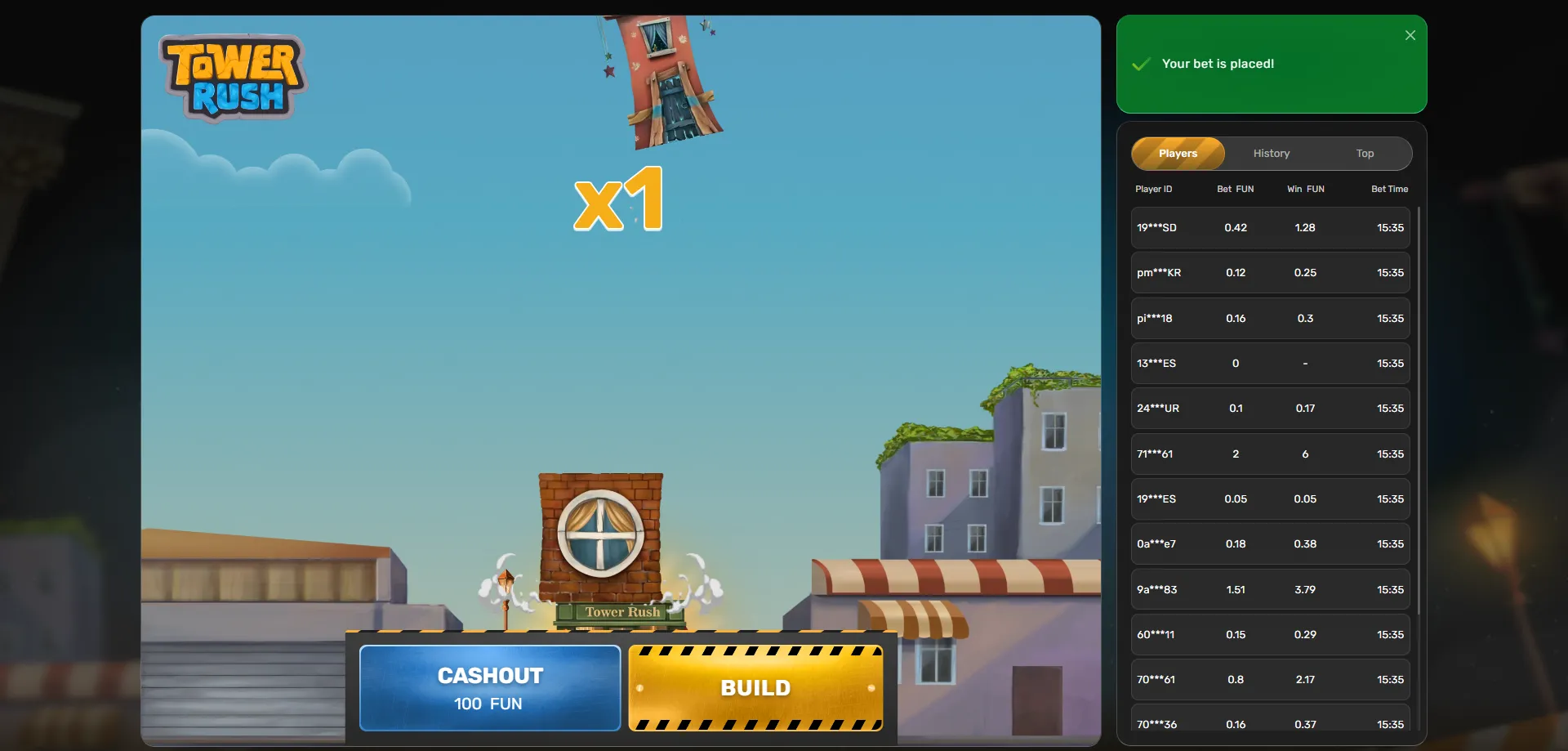
Understanding the mechanism behind Tower Rush does not unlock a cheat code, but it does set rational expectations — which is arguably the most valuable asset any gambler can carry into a session.
Tower Rush is powered by a certified Random Number Generator (RNG) developed by Galaxsys. Before each round begins, the RNG pre-determines the crash point — the multiplier value at which the tower will collapse. This value is cryptographically hashed and committed before any bets are accepted for that round. Players can verify each round's predetermined outcome after it concludes using the game's provably fair system, which provides the seeds used to generate the result.
What this means practically:
The practical implication for your tower rush strategy is straightforward: focus entirely on what you can control — your stake size, your cash-out threshold, and your session budget. Everything else is determined by an algorithm you cannot influence.
If you want to build on the strategy knowledge covered here, two additional resources on this site are worth bookmarking. The How to Play Tower Rush – Game Guide walks through the mechanics step by step, making it the ideal starting point for players brand new to the crash format. For a deeper dive into the statistical side, the Tower Rush RTP and Volatility page breaks down what that 97% return figure actually means in practice and how high volatility shapes your session-to-session results.
The honest answer is: yes, with clearly defined limits. No tower rush strategy can change the RNG-determined crash points or manufacture wins on demand. The 97% RTP is a long-run statistical average, not a session guarantee. What a well-chosen strategy genuinely delivers is structure — a framework that prevents impulsive oversizing, manages bankroll depletion, and keeps your decision-making rational during the emotional pressure of a rising multiplier.
The single-bet and low-size approaches are the most sustainable choices for the majority of players, especially those new to crash-format games. The D'Alembert and Fibonacci systems offer moderate progressive structure without the catastrophic escalation risk of a full Martingale sequence. High-coefficient plays can be rewarding when ring-fenced to a small portion of a larger bankroll.
Above all, treat the demo mode as a genuine training ground before committing real rupees. Tower Rush's free-play version is functionally identical to the real-money game — use it to stress-test whichever strategy appeals to you, measure how your chosen cash-out threshold performs across fifty or a hundred rounds, and only transfer to funded play when the approach feels natural rather than forced. That combination of disciplined strategy, provably fair transparency, and a competitive 97% RTP makes Tower Rush one of the more player-friendly crash titles available in 2026.
Sign up now to receive an exclusive boost on your first deposit. Play Tower Rush with double the power!
🎯 Play Tower Rush🔒 18+ · T&C Apply · Play Responsibly